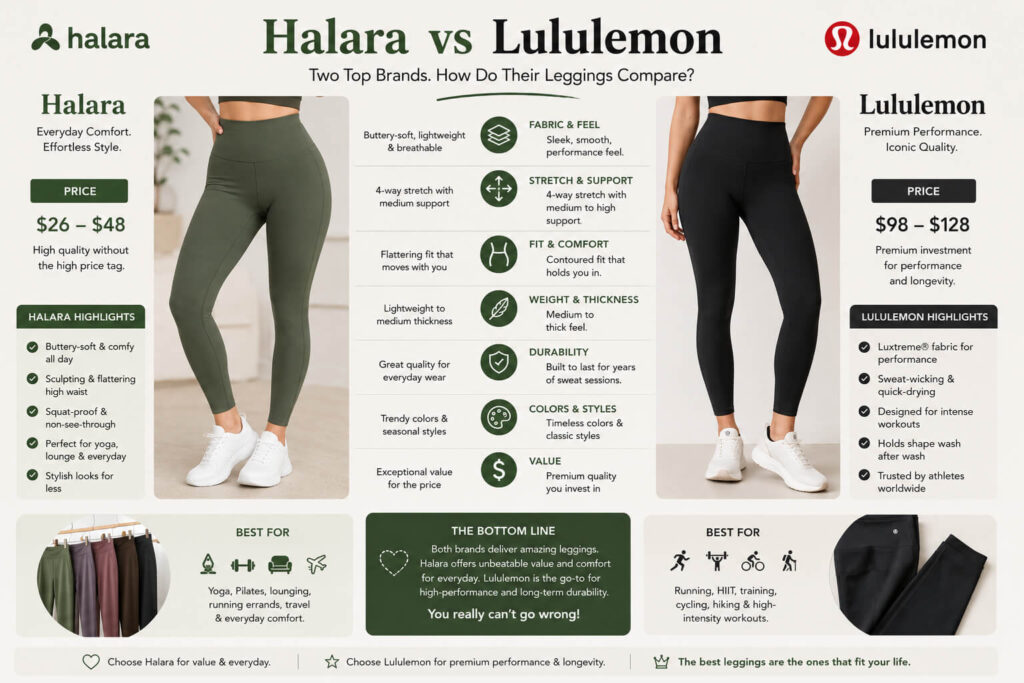
Lululemon leggings start around $98. Halara’s comparable styles run $25–$55. That’s roughly a 2–4x price gap depending on the exact pieces — so the real question isn’t just “which is better,” it’s whether that price difference actually buys you something meaningful. This guide breaks down fabric technology, performance, durability, and who each brand is actually built for, based on aggregated independent reviews and direct brand comparisons current as of mid-2026.
Quick Verdict: Halara vs Lululemon at a Glance
| Factor | Halara | Lululemon |
|---|---|---|
| Average legging price | $25–$55 | $98–$128 |
| Fabric technology | Polyester-spandex blends, moisture-wicking | Proprietary fabrics (Nulu™, Luxtreme™, Luon™), engineered and rigorously tested |
| Best suited for | Low-to-moderate activity, yoga, walking, casual wear | High-intensity training, running, studio classes |
| Durability | Some reports of fabric losing elasticity over time | Built for long-term shape retention across years of use |
| Sizing | XS–3XL, inconsistent across styles | More consistent, extensively size-tested |
| Sustainability | Some recycled materials, less transparency | More established sustainability program, resale initiative |
| Value proposition | Trendy, accessible, budget-friendly | Premium investment for serious, frequent activewear use |
Is Lululemon Objectively Better Made?
Yes — this is one of the more clear-cut conclusions across independent comparisons. Multiple sources agree that <cite index=”19-1″>Lululemon has objectively better quality, construction, and material technology, with fabrics engineered for high performance, durability, and shape retention over many years of use</cite>. Lululemon’s <cite index=”19-1″>buttery-soft Nulu™ and supportive Luon™ fabrics have set industry standards</cite>, backed by rigorous testing that Halara’s faster-moving, trend-driven production model doesn’t match. Halara, by contrast, <cite index=”23-1″>relies primarily on polyester-spandex blends focused on moisture-wicking, breathability, and quick-drying properties for low-to-moderate activity</cite>, with some users reporting the fabric <cite index=”23-1″>losing elasticity over time</cite> — a durability gap that becomes more noticeable the more intensely and frequently you wear the pieces.
Where the Price Gap Gets Harder to Justify
Here’s the more interesting finding: the price gap isn’t purely proportional to the quality gap, at least for casual use. One reviewer who tested Halara’s UltraSculpt leggings specifically summarized the comparison this way: <cite index=”22-1″>Halara isn’t trying to be Lululemon — the fabric quality isn’t identical, and for high-impact running or intense CrossFit, more compression and durability may be needed — but for yoga, walks, errands, and low-to-mid intensity workouts, Halara does the job beautifully at a fraction of the price</cite>. In other words, if your actual use case is casual and low-to-moderate intensity, you may be paying Lululemon’s premium for performance capabilities you’re not using.
Social sentiment reflects this split, too — reviews are genuinely polarized, with <cite index=”20-1″>some shoppers loving their Halara pairs as a close Align-legging alternative, while others report seeing see-through fabric or lopsided seams</cite>, a reminder that Halara’s quality is less consistent piece to piece than Lululemon’s more rigorously tested lineup.
Head-to-Head: Where Each Brand Wins
1. Performance for High-Intensity Training
Clear win for Lululemon. Multiple comparisons agree that <cite index=”24-1″>Lululemon is built for high-intensity workouts with compression, breathability, and sweat resistance, while Halara suits low-impact activities like yoga and casual wear</cite>. If you’re training seriously — running, CrossFit, heavy lifting — Lululemon’s engineering advantage is real and consistently confirmed across sources.
2. Price and Accessibility
Clear win for Halara. At roughly a quarter to a half of Lululemon’s price, Halara lets you build a full activewear wardrobe, experiment with trends, and replace pieces more often without the same financial commitment.
3. Durability and Long-Term Value
Lululemon wins for anyone using activewear frequently and intensely over years — its fabrics are specifically engineered for shape retention over long-term use. For occasional or casual wear, Halara’s durability is generally adequate, though it’s the category most likely to show wear (or fabric inconsistency) over time.
4. Style Variety and Trend Speed
Halara wins clearly here — new colors, silhouettes, and viral styles (like the crossover waistband leggings) drop constantly, while Lululemon’s more classic, minimalist aesthetic changes more slowly by design.
5. Sizing Consistency
Lululemon has the edge, backed by more extensive size testing and a more consistent fit across its narrower, more stable product lineup. Halara’s broader, faster-moving catalog shows more sizing variability between styles, as covered in our detailed sizing guide.
6. Sustainability and Transparency
Lululemon has a more established program here, including recycled materials and a resale initiative, with stated sustainability goals. Halara uses some recycled fabrics but is generally viewed as less transparent about its practices in direct comparisons.
7. Customer Service and Shopping Experience
Lululemon generally offers <cite index=”23-1″>superior service and reliability</cite>, while Halara’s overseas shipping model and customer service track record <cite index=”23-1″>require more patience in exchange for the cost savings</cite>.
A Simple Framework for Deciding
Based on how independent comparisons consistently frame the decision:
- Budget under $50 per item, or want trendy variety? → Halara
- Willing to invest $100+ per item for longevity? → Lululemon
- Workouts are high-impact (running, CrossFit, heavy training)? → Lululemon
- Workouts are low-to-moderate (yoga, walking, errands)? → Halara works well
- Style preference is bold and frequently changing? → Halara
- Style preference is classic and minimalist, built to last years? → Lululemon
- Sustainability and ethical transparency are non-negotiable? → Lululemon currently has the edge
Frequently Asked Questions
Is Halara a good dupe for Lululemon? For casual, low-to-moderate activity, many reviewers find Halara a reasonable, budget-friendly alternative, particularly for the popular crossover-waistband leggings. For high-intensity training, the fabric technology gap becomes more noticeable.
Why is Lululemon so much more expensive than Halara? Lululemon invests heavily in proprietary, rigorously tested fabric technology (like Nulu™ and Luxtreme™) engineered for long-term durability and high-performance use, while Halara prioritizes accessible pricing with simpler polyester-spandex blends.
Is the Lululemon price difference actually worth it? It depends on your use case. For frequent, high-intensity training, most comparisons agree the investment pays off in durability and performance. For casual, everyday, or low-impact use, the price gap is harder to fully justify.
Does Halara fabric hold up as well as Lululemon over time? Generally no — some Halara users report the fabric losing elasticity over time, while Lululemon is specifically engineered for shape retention over years of regular use.
Which brand has better sizing, Halara or Lululemon? Lululemon generally has more consistent sizing, backed by more extensive testing, while Halara’s sizing varies more across its broader, faster-moving product catalog.
Final Thoughts
The price gap between Halara and Lululemon is real, and so is the quality gap — Lululemon’s fabric technology, durability, and sizing consistency are objectively more advanced, and that shows up clearly for anyone doing serious, frequent, high-intensity training. But the price difference isn’t uniformly “worth it” for every shopper: if your activewear needs are mostly casual, low-to-moderate intensity, and style-driven, Halara delivers a genuinely comfortable, much more affordable option without asking you to pay for performance capabilities you may never use. The honest answer to “is the price difference justified” is: yes, if you need what that price is paying for — and not really, if you don’t.
Related Reading
- Halara vs Nike: Which Activewear Brand Offers Better Value in 2026?
- Is Halara Worth It? Honest Price vs Quality Breakdown
- Is Halara True to Size? A Detailed Fit Comparison
Disclosure: This article is based on independently gathered customer reviews and comparative testing coverage available as of mid-2026. It is not sponsored by Halara or Lululemon.