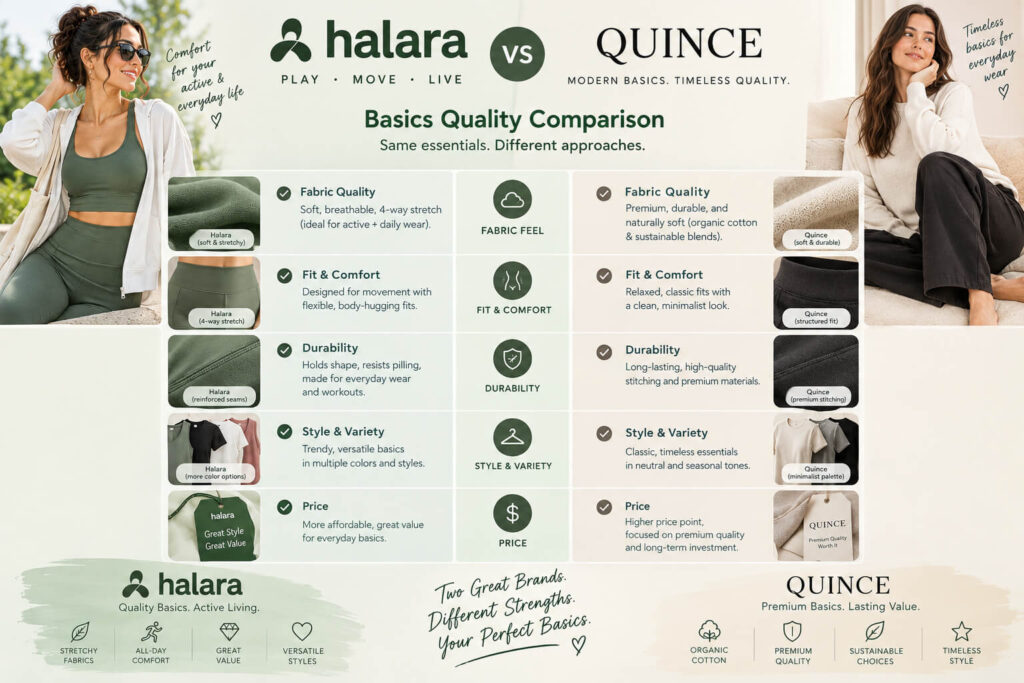
Halara and Quince both promise a version of “more for less,” but they’re solving for different things. Halara is chasing trend speed and low price points in activewear; Quince is chasing premium materials — cashmere, European linen, Italian leather — at prices well below traditional luxury retailers by cutting out the middleman. Here’s how they actually compare when you put them side by side.
Brand Background
Halara is a fast-fashion-adjacent athleisure brand that (cite index=”46-1″>gained popularity through platforms like TikTok for fashionable yet functional clothing, targeting young women who want stylish leggings, workout dresses, and casual wear that transitions from the gym to everyday life without a hefty price tag</cite>.
Quince takes a fundamentally different approach: it’s a (cite index=”49-1″>direct-to-consumer brand founded in 2018 and headquartered in San Francisco that ships directly from factories to cut out the middleman, which is how it offers materials like organic linen, cashmere, and Italian leather at prices 30-70% lower than brands like Everlane and Dagne Dover</cite>. Quince has also expanded well beyond apparel into (cite index=”49-1″>men’s styles, baby clothes, bedding, home goods, luggage, and fine jewelry</cite> — and even, more recently, into gourmet food.
1. Price Comparison 💰
Both brands market themselves as “affordable,” but they’re affordable relative to very different reference points.
- Halara: (cite index=”46-1″>Most items fall in the $20-$60 range</cite>, reflecting a fast-fashion athleisure pricing model.
- Quince: (cite index=”49-1″>Pricing typically runs 30-70% cheaper than high-end brands, though the range varies widely — from around $50 jeans to $225 jackets or more</cite>.
Verdict: Halara is cheaper in absolute dollar terms, but Quince is “cheaper” relative to a luxury benchmark. If you’re comparing a $30 Halara top to a $50 Quince linen top, Halara wins on sticker price — but you’re not comparing equivalent materials, which is really the point of Quince’s whole business model.
2. Quality Comparison 🧵
This is where the two brands diverge most clearly, and it comes directly from reviewers who have tested both.
One extensive reviewer who tested 17 Halara pieces found that while (cite index=”46-1″>the quality is good for the price, it may lack the long-term durability of more premium brands</cite> — and specifically, in a separate detailed review, recommended shopping elsewhere for basics, noting plainly that (cite index=”44-1″>you can find better basics at Aerie or Quince for similar prices</cite>, after finding Halara’s tops, accessories, joggers, and non-athletic skirts had cheap materials and inconsistent sizing.
That same reviewer directly compared a specific item across both brands: after being disappointed with a Halara skirt, she (cite index=”44-1″>bought a similarly colored crepe skirt from Quince for $10 more and found it was everything she wanted the Halara version to be</cite>, concluding that Quince was the better choice for a flowy, travel-friendly, stylish skirt.
Quince’s own quality reputation is built on extensive natural-material sourcing. A reviewer who tested 34 Quince pieces over three years specifically praised the brand’s (cite index=”49-1″>soft, comfortable, good-quality fabrics, especially natural materials like cashmere, linen, and cotton</cite>.
Verdict: Quince consistently comes out ahead on quality in head-to-head reviewer comparisons, particularly for non-activewear basics like skirts, tops, and trousers. Halara’s stronger categories (athletic dresses, leggings, tailored work pants) hold up better against Quince’s more general basics.
3. Style and Product Focus 👗
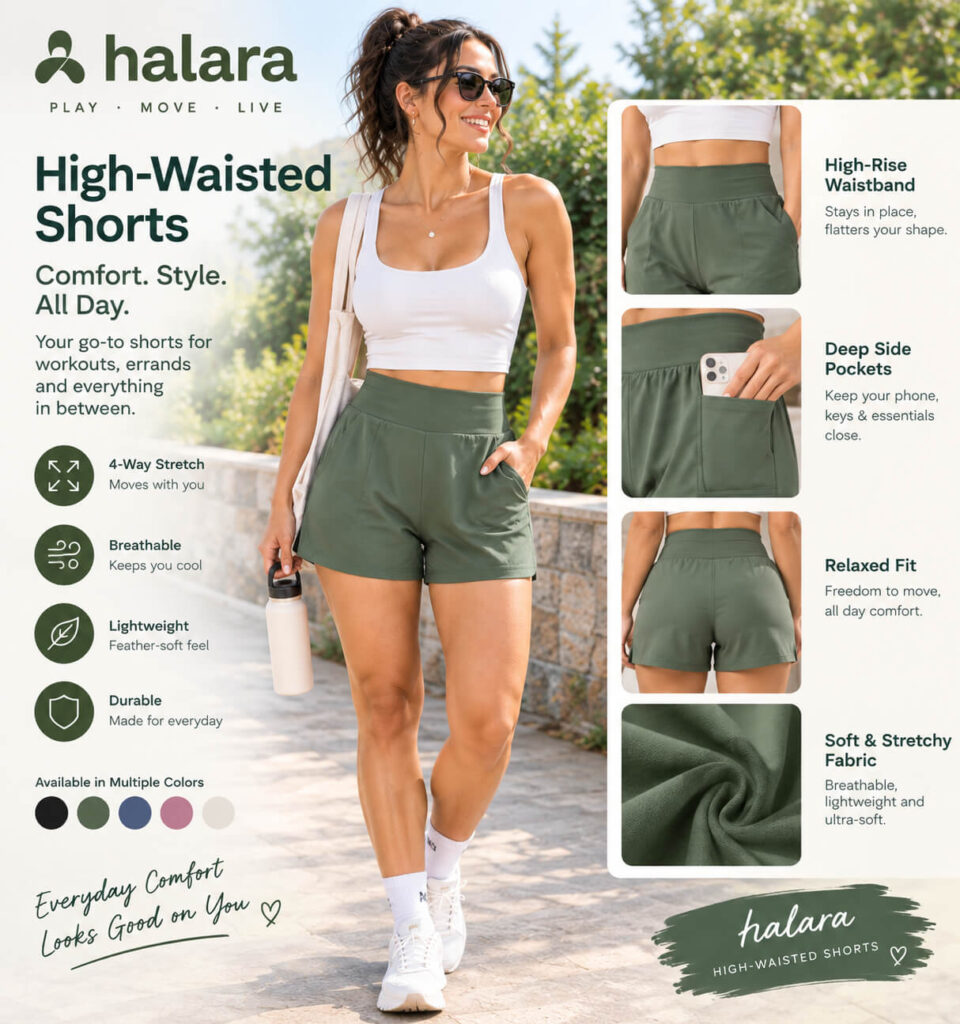
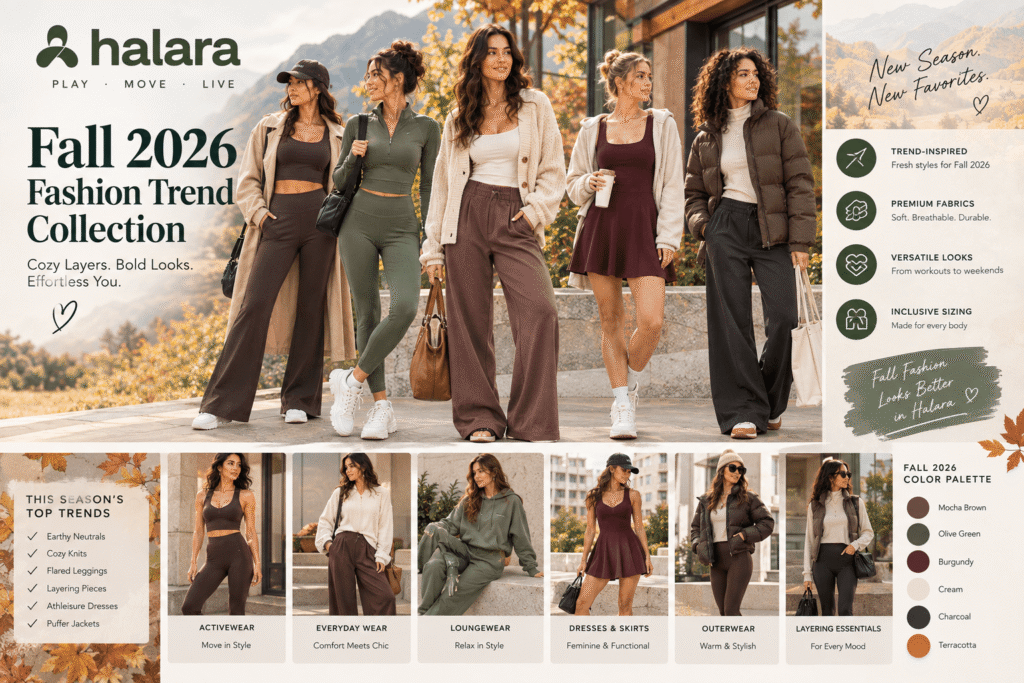
Halara’s identity centers on (cite index=”46-1″>leggings, sports bras, tennis skirts, versatile dresses, and comfortable loungewear, with a youthful, sporty, always-on-trend look built around vibrant colors, high-waisted cuts, and viral designs</cite>.
Quince leans toward timeless, natural-material essentials — linen trousers, cashmere sweaters, and structured basics designed to last multiple seasons rather than chase a specific trend cycle. Social media comparisons between the two brands’ linen trousers specifically highlight Quince’s fabric texture and finish as a differentiator, with one reviewer describing the (cite index=”47-1″>quality, cut, and fit as spot-on and “luxury for less”</cite> after comparing two colorways of Quince’s European linen pants.
Verdict: If you want trend-driven athleisure, Halara is built for that. If you want investment-adjacent basics in natural materials that don’t chase seasonal trends, Quince is the clear choice.
4. Work Pants: A Direct Category Overlap
This is one of the few categories where the two brands genuinely compete head-to-head, and it’s worth calling out specifically. Halara’s work pants have developed a strong independent following, with fit reviews across multiple body types praising them as (cite index=”48-1″>the most comfortable work pants they’ve found — stretchy, pull-on, and polished-looking enough for office wear</cite>. Given that Halara’s own longtime reviewers already single out work pants and tailored trousers as one of the brand’s strongest categories, this is arguably the closest Halara comes to matching Quince’s reputation for polished basics — even if Quince still generally wins on fabric quality for pieces like linen trousers.
Verdict: For work pants specifically, Halara offers a genuinely competitive, much cheaper alternative — this is the category where the price-to-quality gap between the two brands narrows the most.
5. Sizing and Fit
Halara offers (cite index=”46-1″>inclusive sizing, often ranging from XS to 3X, though fits can be inconsistent item to item</cite>, making it worth checking the specific size guide for each product rather than assuming brand-wide consistency.
Quince doesn’t have the same volume of size-inconsistency complaints in reviewer coverage, though as with any DTC brand, checking size charts per item remains good practice.
Verdict: Halara’s broader size range (up to 3X) may be an advantage for some shoppers, but expect more fit variability than you’d get with Quince.
6. Sustainability
Halara (cite index=”46-1″>operates on a model similar to fast fashion, with a primary focus on trend turnover and affordability rather than sustainability, and limited public information on its manufacturing practices</cite>.
Quince markets more directly around responsibly sourced natural materials (organic linen, ethically sourced cashmere), though as with most DTC brands, the depth of that commitment varies by category and isn’t always independently certified to the same degree as dedicated sustainable-fashion brands.
Verdict: Quince’s natural-material focus gives it a stronger sustainability starting point than Halara’s synthetic-heavy catalog, though neither brand should be assumed to meet the bar of a dedicated ethical-fashion label without further research.
Final Verdict: Which Should You Choose?
| Factor | Halara | Quince |
|---|---|---|
| Price | $20-$60, fast-fashion pricing | 30-70% below luxury pricing, wider range ($50-$225+) |
| Quality | Good for the price, inconsistent by category | Consistently praised, especially natural materials |
| Style | Trend-driven athleisure | Timeless, natural-material basics |
| Best category overlap | Work pants (genuinely competitive) | Linen, cashmere, structured basics |
| Sizing | XS-3X, fit varies by item | Standard DTC sizing, less inconsistency reported |
| Sustainability | Fast-fashion model, limited transparency | Stronger natural-material focus |
| Best For | Budget-conscious, trend-focused athleisure shoppers | Shoppers wanting premium materials at a discount |
Bottom Line: These brands aren’t really substitutes for each other so much as tools for different jobs. For trend-forward activewear and leggings at rock-bottom prices, Halara remains hard to beat. But for basics you actually want to last — skirts, trousers, sweaters, anything where fabric quality matters — reviewers who’ve tested both consistently point to Quince as the better investment, even at a somewhat higher price point. The one place they genuinely compete is work pants, where Halara’s tailored, stretchy styles have earned a loyal following at a fraction of Quince’s cost.