Halara and Pact rarely come up in the same sentence — one is a viral athleisure brand built on stretch synthetics and social media trends, the other is a nearly two-decade-old organic cotton specialist built around fair trade certification. But they do overlap enough in casual basics that they’re worth comparing directly, especially if sustainability and material transparency matter to your decision. Here’s the full picture.
Brand Background
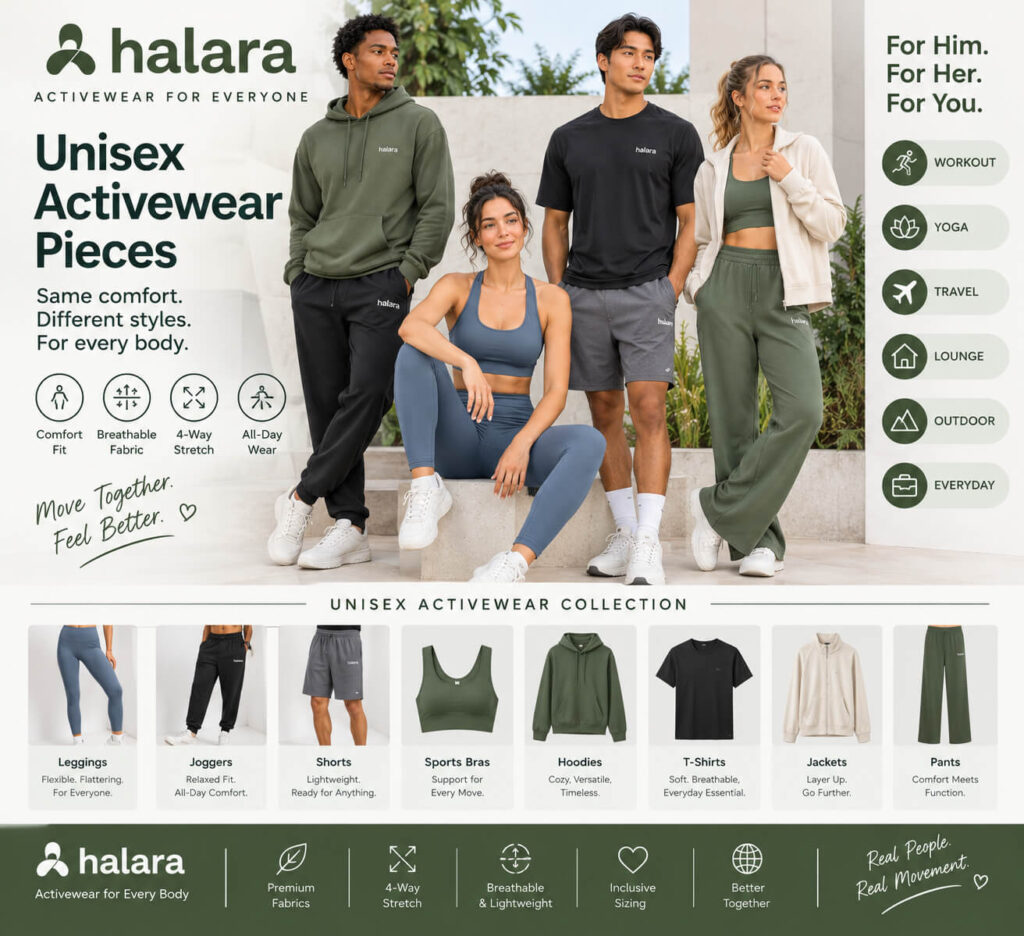
Halara launched in 2020 as a Chinese direct-to-consumer athleisure brand, built around leggings, exercise dresses, and skorts, with rapid, trend-driven production cycles.
Pact (formerly PACT Apparel) is a much older company — (cite index=”18-1″>founded 15 years ago as an all-organic cotton underwear company, and one of the earliest widely available sources of ethical, 100% organic basics</cite>. It’s based in Boulder, Colorado, and (cite index=”25-1″>operates in the apparel industry producing clothing and home goods made from non-GMO organic cotton, manufactured in factories that meet fair trade standards</cite>.
1. Materials and Transparency: The Biggest Differentiator
This is where the two brands diverge most sharply — and it’s the main reason they get compared at all.
Halara’s material sourcing has been directly scrutinized and found lacking. One sustainability-focused investigation concluded that (cite index=”19-1″>Halara selects suppliers carefully but won’t disclose who they are or where they’re located, and this matters especially with cotton, since sourcing in parts of China carries documented forced labor risk that can’t be verified without a published supplier list</cite>. The same investigation noted plainly that (cite index=”19-1″>a brand that publishes nothing can’t be verified, and in ethical fashion research, that absence itself is the finding</cite>. A separate environmental review found that (cite index=”24-1″>Halara doesn’t use recycled polyester, organic cotton, or other sustainable material alternatives</cite>, relying instead on standard synthetic blends.
Pact, by contrast, has built its entire brand identity around verified organic cotton. (cite index=”21-1″>All Pact products are based in organic cotton, with a company-wide commitment to Global Organic Textile Standard (GOTS)-certified cotton, manufactured in Fair Trade-Certified factories</cite>. Rather than treating this as a single blanket claim, Pact has developed (cite index=”21-1″>six distinct organic cotton fabric platforms — different blends and weights, some incorporating small amounts of elastane, recycled poly, or linen alongside organic cotton — each engineered for a different use case</cite>.
Verdict: If verified material sourcing and supply chain transparency matter to you, this isn’t a close comparison — Pact publishes certifications and fabric details that Halara simply doesn’t offer.
2. Who Recommends Which Brand for What
Interestingly, sustainability-focused publications specifically position Pact as the go-to Halara alternative for casual basics. One eco-fashion review noted that (cite index=”19-1″>Pact is the best bet for casual and everyday alternatives to Halara beyond activewear, offering a wide range of women’s dresses, tops, pants, and loungewear, available for both women and men, with a transparency story that actually holds up</cite>.
This suggests the two brands aren’t really seen as direct competitors by people who track ethical sourcing — Pact is treated as the “better” alternative specifically because Halara’s transparency doesn’t hold up to scrutiny.
3. Quality and Consistency
Pact’s quality reputation is built on long-term consistency. One reviewer who tested organic activewear brands extensively wrote that (cite index=”22-1″>Pact’s quality has held up through years of wear and washing, making it one of the easiest organic activewear brands to recommend to almost anyone</cite>, having personally worn the brand for over a decade.
Halara’s quality, as covered extensively elsewhere, is more categorically inconsistent — strong in leggings and structured pants, weaker in tops and accessories, based on independent multi-item testing.
That said, it’s worth noting Pact isn’t immune to criticism either. A more recent investigation raised concerns about (cite index=”18-1″>a customer reporting an allergic skin reaction to a Pact order, alongside broader questions about whether Pact’s public sustainability statistics — like the commonly repeated claim that organic cotton uses significantly less water and energy — have held up to scrutiny over time</cite>. This is a single anecdotal case rather than a systemic pattern, but it’s a fair reminder that even a well-established “clean” brand isn’t beyond scrutiny.
Verdict: Pact has a stronger long-term quality reputation overall, though it’s not flawless. Halara’s quality is more of a mixed bag depending on category.
4. Price Comparison 💰
Both brands sit in a broadly similar accessible-to-mid-range price bracket for basics, though they’re not identical in structure. Halara tends to run slightly cheaper on a per-item basis for trend-driven activewear pieces, while Pact’s pricing reflects its certification and fair trade manufacturing costs — generally landing in a comparable range for simple basics like tees, underwear, and loungewear, with Pact also offering (cite index=”23-1″>a free membership program that earns 5% credit on all orders</cite>, which can offset some of the price difference over repeat purchases.
Verdict: Price alone isn’t a strong differentiator here — the real trade-off is fabric technology and trend-driven style (Halara) versus certified organic basics and consistency (Pact).
5. Style and Product Range
Halara covers a broad, trend-driven catalog: exercise dresses, tennis skirts, leggings, shapewear, denim, sleepwear, and more, updated constantly to chase current fashion cycles.
Pact stays closer to true basics: tees, underwear, loungewear, simple dresses, and activewear built around comfort and longevity rather than trend-chasing. It’s a narrower catalog by design, prioritizing a smaller number of well-made, repeat-purchase staples over constant new drops.
Verdict: If you want to stay current with trends, Halara’s range is far broader. If you want a smaller number of dependable, simple basics you can restock for years, Pact’s narrower focus is the better fit.
Final Verdict: Which Should You Choose?
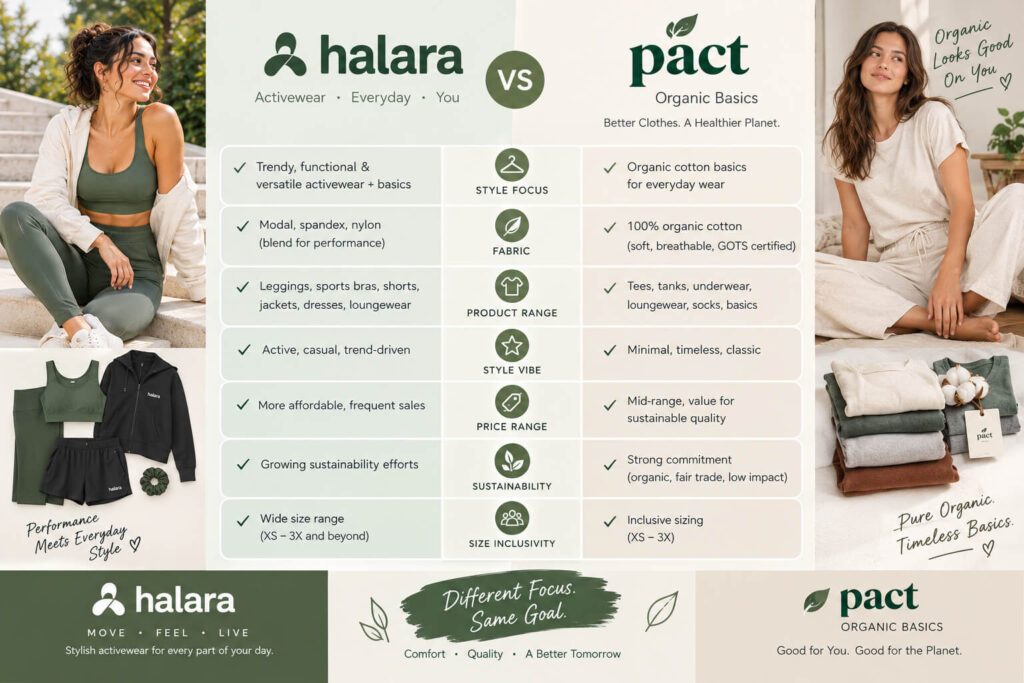
| Factor | Halara | Pact |
|---|---|---|
| Materials | Undisclosed suppliers, synthetic-heavy | GOTS-certified organic cotton, Fair Trade factories |
| Transparency | No published supply chain info | Certifications and fabric details published |
| Quality | Inconsistent by category | Generally consistent over years of wear |
| Price | Slightly cheaper for trend pieces | Comparable for basics, with a credit-back membership |
| Style range | Broad, trend-driven, constantly updated | Narrower, basics-focused, built for longevity |
| Best For | Trend-conscious shoppers on a budget | Shoppers prioritizing verified, sustainable basics |
Bottom Line: These two brands serve genuinely different priorities. If trend-forward variety and low prices matter most, Halara gives you more to choose from. If verified organic materials, fair trade manufacturing, and long-term durability matter more than staying on-trend, Pact is the brand sustainability-focused reviewers consistently point to as the more transparent, better-vetted choice for basics.