Everyday protection comparison
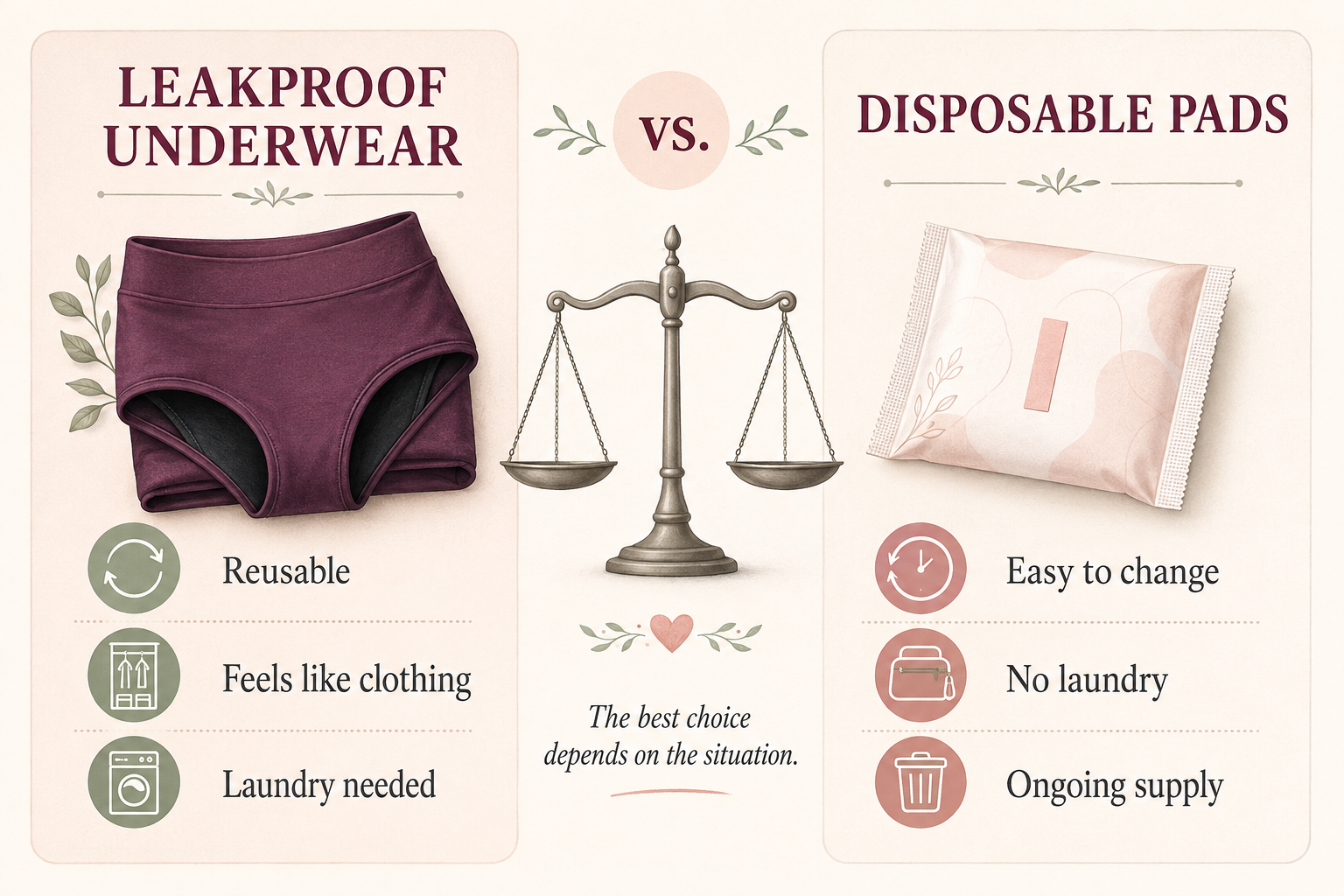
Leakproof underwear and disposable pads can both make bladder leaks easier to manage, but they fit into daily life very differently. One feels more like clothing and requires laundry; the other is quick to replace but creates an ongoing supply to buy and carry.
The honest answer is that neither option wins every situation. Your best choice depends on how much you leak, how often you can change, what you wear, where you are going and whether washing reusable protection feels manageable. Many people get the most practical result by keeping both available.
In this comparison
Leakproof underwear vs pads: the quick comparison
| What matters | Leakproof underwear | Disposable pads |
|---|---|---|
| Feel | Closer to regular underwear, with a thicker gusset | A separate absorbent layer attached inside underwear |
| Changing | Usually requires changing the garment | Faster to replace without changing underwear |
| Laundry | Wash and air-dry after use | No washing required |
| Repeat use | Reusable when cared for correctly | Single-use and needs regular replacement |
| Travel | Less to pack initially, but used pairs need storage | Easy to change; enough replacements must be packed |
| Under clothing | Can look and move more like ordinary underwear | May shift, bunch or show depending on fit and thickness |
Which feels more comfortable and discreet?
Leakproof underwear has the advantage of being one garment. There is no adhesive strip to reposition and no separate pad edge to rub against the skin. A well-fitting pair can move naturally under jeans, dresses or sleepwear. The trade-off is a thicker absorbent panel that will not feel identical to a lightweight cotton brief.
Pads offer familiar, adjustable protection and come in many shapes and absorbency levels. Their comfort depends heavily on the pad and the underwear holding it. A pad can feel secure in a fitted brief but may move inside loose underwear or during exercise.
For leggings and close-fitting outfits, smooth or seamless leakproof styles can create a cleaner outline. For quick changes at work or in a public restroom, pads usually win because the rest of your clothing can stay in place.
Protection is about more than capacity
A large absorbency number does not automatically prevent leaks. The absorbent area needs to sit where leakage happens, leg openings need to stay close to the body and the product must match the speed and amount of moisture.
The National Institute of Diabetes and Digestive and Kidney Diseases explains that stress incontinence can occur with coughing, laughing, exercise or lifting, while urgency incontinence involves a strong urge followed by leakage before reaching a toilet. Those patterns can require different change plans even when the total amount seems similar.
Leakproof underwear may be convenient for a few drops, predictable stress leaks or all-day backup when the selected capacity is appropriate. Pads can be more practical when protection needs to be changed several times without removing trousers or tights. For heavy, continuous or rapidly occurring leakage, seek advice about products designed for that level of need.
Which costs less over time?
Reusable underwear costs more upfront. Disposable pads spread the expense across repeated purchases. To compare them fairly, use your actual habits rather than a generic promise about annual savings.
Multiply the number of pads used each day by the cost per pad, then by 30. Compare that monthly figure with the cost of enough reusable pairs for a comfortable wash rotation. Remember to include occasional replacement and laundry in the reusable side.
Someone using pads every day may reach the break-even point sooner than a person who needs protection only twice a month. Reusable underwear also has value beyond cost if it reduces the irritation, shifting or bulk someone experiences with pads. Conversely, avoiding extra laundry may be worth more than the potential savings for another person.
EverLeakProof Full Coverage is available in S–4XL with a brand-stated 3.4 fl oz capacity. Compare measurements and the current price first.
Check Sizes & Today’s Price →Official EverLeakProof store · 30-day free size-exchange promise
The better choice for different routines
At work
Choose leakproof underwear when your protection level is predictable and you want something that feels integrated with your outfit. Choose pads if you expect to change during the day and have limited privacy or time.
During exercise
A secure, stretch-friendly leakproof pair can avoid adhesive movement. Start with walking or a shorter workout. Pads remain useful if you prefer changing immediately after activity without replacing underwear.
For travel
Leakproof underwear reduces the number of individual pads you need to carry, but used garments require a sealed wet bag until they can be washed. Pads are easier to discard and replace, but you need enough for delays and long travel days. A reusable pair plus one or two disposable backups is often the least stressful combination.
Overnight
Fuller-coverage reusable underwear can stay in place without an adhesive strip, but front-to-back coverage and capacity matter. A high-absorbency pad may be easier to replace if you wake during the night. Test overnight protection cautiously before depending on it away from home.
Washing reusable underwear correctly
Reusable protection only remains useful when the absorbent layers are cared for properly. Follow the exact garment label. EverLeakProof recommends cold washing and natural air drying, and advises against bleach and fabric softener because they can affect absorbency and fabric performance.
Own enough pairs to allow complete drying rather than forcing a damp pair back into rotation. If laundry access is limited, pads may remain the more dependable choice for part of the week.
Our verdict: a flexible combination often works best
Choose leakproof underwear if you want reusable everyday backup, dislike the feel of adhesive pads and can maintain a wash rotation. Choose pads when fast changes, no laundry and carrying individually wrapped protection matter most.
You do not have to commit to one system. Leakproof underwear can cover predictable days at home, work or overnight, while pads remain in your bag for unexpected changes and travel. For help matching absorbency and fit, see our guide to choosing leakproof underwear. You can also read our detailed EverLeakProof review.
Review the current Full Coverage colors, S–4XL size chart and five-pack offer on the official product page.
View Colors, Sizes & Current Offer →Affiliate link · You pay no additional cost
Frequently asked questions
Can leakproof underwear completely replace pads?
It can reduce or replace pads for some people with light, predictable leakage. Others prefer a combination, particularly for travel, longer days or changing away from home.
Can I wear a pad inside leakproof underwear?
Some people combine products, but an adhesive pad may not attach well to every technical fabric or may prevent the built-in gusset from working as intended. Check the garment manufacturer’s instructions.
How many reusable pairs do I need?
For occasional use, two or three may be enough. Daily users often find a five-pair rotation more practical for washing and air drying.
When should I speak to a doctor?
Talk to a qualified healthcare professional if leakage is new, frequent, worsening, painful, accompanied by other symptoms or affecting daily activities. Protective products manage moisture but do not treat the underlying cause.